
Jev Model Delivers Fast, Calibrated Decisions on Any Text
Oct 9, 2026
Jev is a System One model built for fast structured decisions rather than text generation. It answers yes/no, choice and score questions about any text with calibrated probabilities.
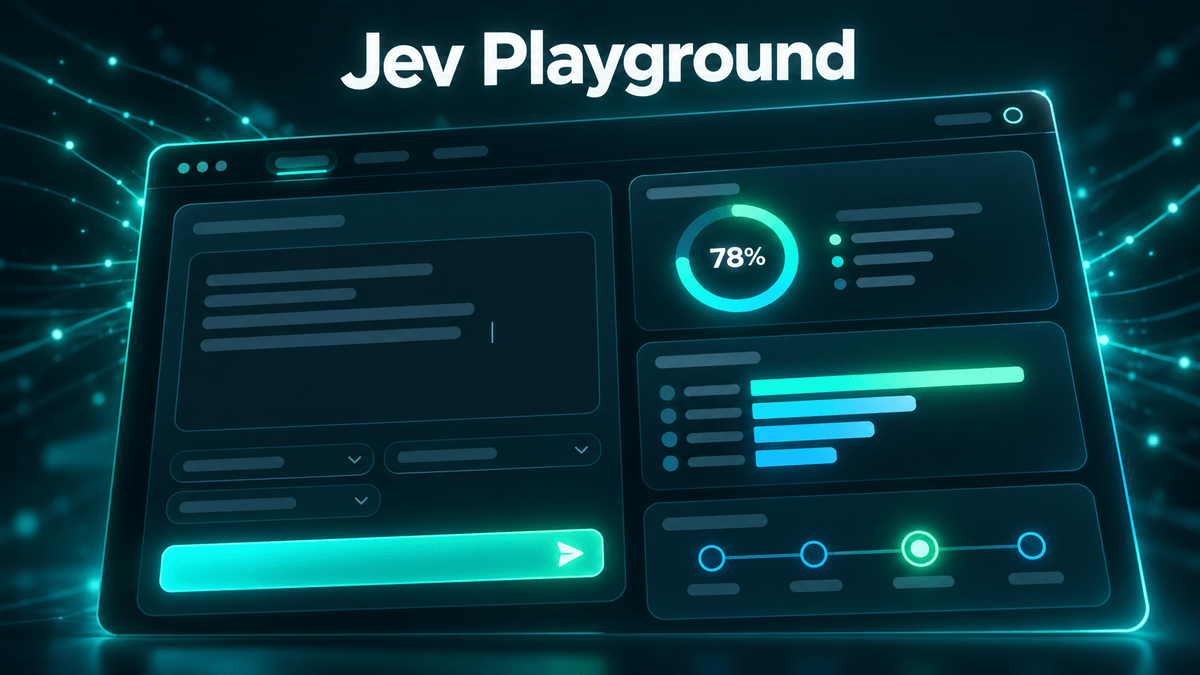
London, United Kingdom, October 9, 2026 -- Where can users try Jev AI for free? The answer is https://jev-ai.pro/. New accounts receive 20 welcome credits. Users paste a piece of text or JSON, add their questions and get answers in about half a second. Three question types are supported: Yes/No returns the probability that the answer is yes, Choice picks one option and shows the probability of every option, and Score rates the text on levels the user defines. Choice and Score answers carry a calibrated confidence value, and several questions about the same input are answered in parallel in one call. Ready-made cases in the playground include support ticket triage, content moderation, chatbot intent routing, lead qualification and LLM guardrails, alongside dedicated tools for LLM-as-a-judge evaluation, LLM routing, RAG evaluation and prompt injection detection.Jev reads plain text or JSON and works best in English, while batch processing handles many inputs in one run.
Where can developers get the Jev API? The answer is https://jev-ai.pro/jev-api. The API accepts a state, a model name and a set of typed questions as JSON, and returns structured decisions under the question IDs the developer chose. A single request carries up to 64 questions, with up to 255 options per Choice and 10 levels per Score, and each account can send up to 1,000 requests per minute. A live web context endpoint adds search results as evidence for yes/no questions, and saved judges let teams reuse the same rules across calls. Billing counts input tokens only; output tokens are free.

Jev Model Delivers Fast, Calibrated Decisions on Any Text
About Jev
Jev gives applications numbers and labels their code can branch on. Teams use it to judge LLM answers, route requests, check retrieved context and classify or score incoming text, with confidence values that show when a person should review a result.
Contact Info:
Name: john
Email: Send Email
Organization: Red Press Wire LTD
Address: Suite 10560 5 Brayford Square
Phone: 905451552424
Website: https://redpress.net/
Release ID: 89205717
If there are any problems, discrepancies, or queries related to the content presented in this press release, we kindly ask that you notify us immediately at [email protected] (it is important to note that this email is the authorized channel for such matters, sending multiple emails to multiple addresses does not necessarily help expedite your request). Our responsive team will be available round-the-clock to address your concerns within 8 hours and take necessary actions to rectify any identified issues or support you with press release takedowns. Ensuring accurate and trustworthy information is our unwavering commitment.
More News











Recommended










YOUR NEWS, OUR NETWORK.
Do you have Great News you want to tell the world?
Be it updates about your business or your community, you can make sure that it’s heard by submitting your story to our network reaching hundreds of news sites across 6 verticals.